Artemis was born the daughter of Zeus and Leto, twin sister of Apollo. According to a Greek myth, Artemis was midwife at the birth of her own twin brother. During her birth, her mother experienced no pain unlike the birth of Apollo. From then on Artemis was worshiped as a goddess of childbirth as well. Wilderness, mountains, forests, and uncultivated lands were sacred to her as were the young and unmarried women. She herself was a virgin goddess and never married which is why she probably held such an interest in the young women of her time.
Artemis was often depicted as attractive and sought after by many men who usually died in their pursuit of her. She is usually shown as a young woman in a short tunic and sandals with a quiver and bows. She was an aloof goddess, blood thirsty, and quick to anger and when annoyed, deadly consequences usually ensued.
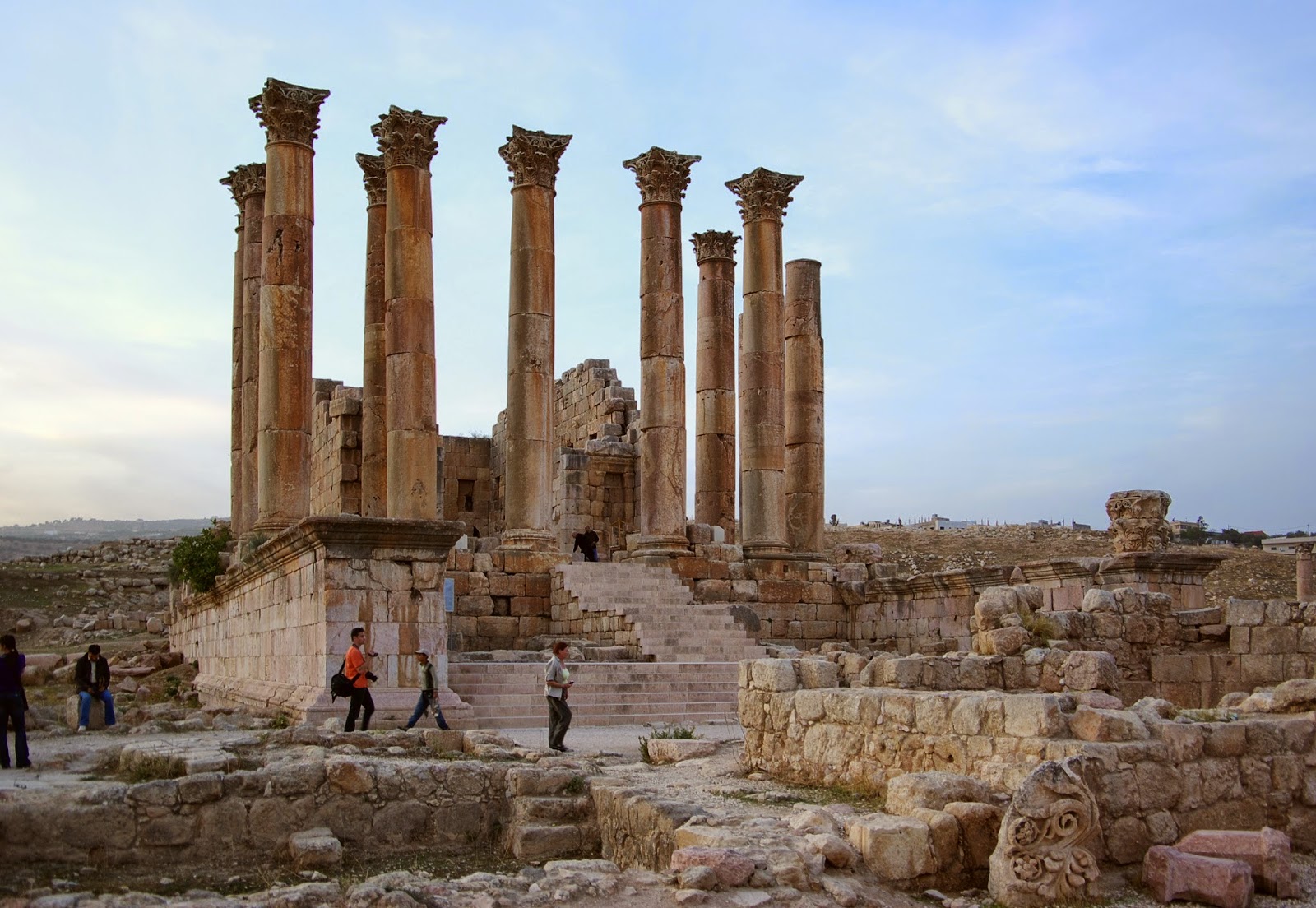
Photo to the left is the Temple of Artemis in Jordan.
Artemis in the Arts
Rembrandt depicted Artemis (called Diana by the Romans) bathing with her nymphs. Several composers even wrote operas based upon some of her male pursuers and their deadly demise.
Discussion
In a male dominated society it is nice to see a female goddess with a focus on protecting and guarding her fellow women. Today more and more we are finally seeing heroines in main stream media (tv, movies, etc). What are some of your favorite female badasses?
Apollo was worshiped for many things including his ability to provide the world with light, music, harmony, and also his provision of punishment and provision of protection of crops and animals. He was a multi-tasking God if you will! Both Gods and mortals alike revered him. Let's find out why!
Birth
Apollo was 1 of the 12 major Olympian deities. He was born son of Zeus and Leto, the daughter of a Titan. Zeus' wife Hera who was known for her jealousy and of course, any woman Goddess or mortal could not be shielded from her infamous wrath. Hera forbade Leto from giving birth to Apollo and his twin sister, Artemis, on fixed firm land. Both children were instead born on the floating island of Delos, which Zeus had fixed to the seabed. Delos became an important shrine to Apollo for both Greeks and Romans. Apollo would grow to embody what the Greek's felt was the ideal of kouros, or male beauty.
Worshiping Apollo

Apollo founded his own oracle, which is a shrine where a prophet reveals the plans of the gods to mortals. Apollo actually entered the ranks of the Greek Gods and Goddesses rather late in the game, suggesting that perhaps he was worshiped elsewhere at first and brought to Greece by traders from Cyprus. The Delphi was the site of the greatest oracle in the ancient world. From the 6th century BCE, the oracle at Delphi was so important that it was consulted by politicians on important questions ranging from government policy to whether or not to invade new areas or build new structures. Its status declined when the Romans adopted Christianity as the imperial religion in the 4th century CE. It was closed for good in 385 CE by emperor Theodosius. The Greeks believed it stood at the center of the world. Interestingly, archaeologists have found that the Oracle of Delphi is located on not one, but two fault lines. Scientists attribute some of the gasses that may have leaked due to this to the reason that people would experience 'visions' and act strangely rather than them being affected by the God Apollo. Below is a link to the history channels short video clip discussing the fault lines and the chemicals, I found it very interesting and gives a modern connection to this ancient historical landmark.
Secrets of the Oracle
Symbols
Apollo can be associated with several symbols such as the swan drawn chariot, bow and arrow, and lyre.
Myths
Greeks regarded Apollo as the keeper of harmony, especially in the civic department of life. He provided laws by which humans could live together in peace. He encompassed the Greek ideals of moderation and reason. Thoughts that essentially defined Greco Roman culture. The phrases on the walls of the oracle at Delphi say "Nothing in excess" and "Know thyself", these phrases are still said and thought of today.
In many myths, Apollo's focus seemed to be righting wrongs done against him to protect his honor. Apollo played a critical role in the Trojan war in the deaths of Achilles and Patroclus.
Apollo in Love
Apollo had many loves, both women and men, many of them ending badly due to death for the most part or unsuccessful attempt on Apollo's part. His downfall seemed to be that he would often give the object of affection a gift or grant a wish like a new ability and his want to please them usually backfired on him. Despite his many failed romances he had many children. With Thalia, goddess of comedy he fathered sacred dancers known as the Corybantes. The nymph Dryope gave birth to a son Aphissus who established the ancient city Oeta. He even fathered many prophets. Apollo's most favored and famous son was the god of medicine, Asclepius.
Apollo in Art
One of the most famous representatives of Apollo is the sculpture in the Temple of Zeus, built around 460 BCE in the sanctuary of Olympia. Apollo has been a feature in art since the Renaissance of the 18th and 16th centuries.
Discusison
Apollo seemed to be a jack of all trades in a sense. He was admired for his ability to live a rational life, putting forth laws to be followed and provide guidelines for living a harmonious life. The Greeks were known for their forward thinking of the time, putting to work the brain and delving in to a deeper world of thought that hadn't been explored. If Apollo were worshiped today still, what are some ideals do you think he would employ? Would be be satisfied with how people interact with one another?
Ares is always depicted as the epitome of strength. He is muscular, tall, and often cruel. In fact, he is notably the most hated God by all of the Olympians.
Birth
Born son of Zeus and Hera, the king and queen of the Gods. He is the ultimate personification of war and strife.
Mythology
 Ares is always mentioned as over zealous for war and blood, and the first one to engage in any battle at any time. In combat he is often characterized by his shining helmet, armor, and sword and arrives to battle in a chariot. In Homer's Iliad which we read in class, Zeus says of his own son, "Most hateful to me are you of all Gods on Olympus, for ever is strife dear to you and wars and fighting." It is interesting to note also that very few myths feature Ares is a main component, he instead is featured in smaller roles in various other myths.
Ares in Art
Much like in literature, in art Ares is depicted as handsome, and a youthful warrior. Most artistic representations of him are sculptures rather than paintings. The most famous sculpture being the Ares Borghese, which was carved in 125 CE and named after the Borghese family which purchased it.
Children of Ares
Ares had many children with many goddesses, nymphs, and mortal women. Most of his children were bloodthirsty like their father, known for their lack of compassion and heart and several met with horrible deaths.
Discussion
We see that not many people favored Ares, or ended up worshiping him as we saw with Aphrodite and will see with other Gods. Why do you think that is? Do you find anything admirable about him? What are some modern day literature foils for Ares that you can think of?
Birth Mythology
Aphrodite is said to have been born when the body of Uranus, the sky god, was dismembered by his son, Cronus. His cut off genitalia fell in to the sea at Cytherea, a small Ionian island on the southwest tip of the Peloponnese. Aphrodite came to life from his seed and arose from the foam. In fact, the Greek word aphros means "foam", thus Aphrodite was born.
Early Life
From Cytherea the West Wind carried Aphrodite to Cyprus where the seasons, known as the Horae cared for her. They dressed her in beautiful exotic clothing and taught her to behave as a seductress. She became the goddess of sensual love and allurement. Her downfall was that although she truck passion in to the hearts of Gods and humans alike, she gave little to no thought about the consequences or cost to those concerned.
Tales
 There are many scandalous stories of Aphrodite, too many to name here. Home, a poet with whom we covered his works The Iliad and The Odyssey, tells of her affair with Ares the God of war while her husband, the hideous Hephaestus was working. Hephaestus had won Aphrodite's hand in marriage after setting a trap for Hera and holding her for ransom. Aphrodite always hated her husband and preferred Ares and other lovers to him. The lovers even employed the use of an Alectryon, or rooster, to warn them when day break had arrived because dawn was when Hephaestus would return home from work. However, the sun god, Helios, saw everything and told Hephaestus who rigged an invisible net to catch the lovers and called the other Gods to ridicule his wife and Ares. The Olympian Gods laughed and Zeus is even reported to have said laughingly, "I wish I could get caught in such a trap!''
Symbols
The myrtle was her sacred tree, the rose her sacred flower, and the dove her sacred bird.
Children
Aphrodite and Ares bore several children, two boys and one girl. The sons, Deimos and Phobos, the daughter, Harmonia. Their sons appeared in battles to cause havoc in the ranks of enemy soldiers. Their names have even been given to 2 moons of the planet Mars. Harmonia their daughter married Cadmus, a Phoenician prince who came to Boetia. They founded the royal house of Thebes.
The Venus de Milo
There are many paintings and sculptures depicting Aphrodite, however one of the most famous is that of the Venus de Milo. Discovered in 1820, and the artist unknown. The arms are broken off, and the mystery of their original position has always fascinated the minds of critics. What do you think Aphrodite would have been holding or doing with her arms?
Worshipping Aphrodite
The photo to the left depicts the Temple of Aphrodite in Aphrodisias. Some regarded her as a goddess of the sea from which she was born. Others such as the Spartans and Thebans worshiped Aphrodite as the goddess of war because of her connection to Ares, god of war. In general, she was most widely worshiped as goddess of fertility.
For thousands of years, Greek Gods a Goddesses have captivated the imaginations of people everywhere. From their mystical powers, to at times human emotions, the Gods and Goddesses of Greece have woven powerful tales of lust, love, beauty, war, revenge, and hate.
I could run on and on about the many Gods and Goddesses but I've chosen some that I am interested in, or that we may have read about in passing through some of the literature we covered this semester. I will be using photos, text, and some video clips I come across that I think will enlighten and intrigue you as you read this blog. I am no professional by any means! So bare with me, as this is a learning experience for me but one that I look forward to. I will do my best to reference everything in case anyone wants more information and don't hesitate to comment with questions or your own insights.
This blog has been created as a final project for my World Lit I Class with Professor G at GPC. I hope it will be fun, informative, and readers can take something away from it! I decided to cover Greek Gods and Goddesses as this has always been a subject that personally interested me and was discussed frequently throughout different literature that we have covered throughout the Spring Semester. So without further adieu, enjoy! :)